
In JavaScript, a primitive value is a data type that is not an object and has no methods. There are six primitive data types: Boolean, Null, Undefined, Number, String, and Symbol (new in ES6). All primitive values are immutable, meaning they cannot be changed.
If you had an infinite supply of sticky notes, you’d keep a small amount of information on them. Simple things can be written on sticky notes (because they’re condescending, and they should be called primitive things). We don’t know what exactly 30 slices of cheese is, and frankly, we don’t care either way. If my wife made a grocery list and wrote a sticky note to my husband to find it, would she need to do this for every item? Objects’ reference values refer to their addresses (addresses where the objects will be found). There is no distinction between two sticky notes because one refers to the same object. JavaScript has a dynamic memory function that is a type of programming language.
As a result, each variable can point to an arbitrary location (rather than a single memory location). All variables have a fixed address, and every variable has a fixed number of bytes. Furthermore, we can assign additional memory to the heap and store the address of that memory in a pointer. Dynamic memory schemes are a type of memory scheme. The interpreter for JavaScript is usually written in C, as opposed to the interpreter for Java. All variables in JavaScript are mapped to objects within the host language (even primitives). When we declare a variable in JavaScript, it is created by the interpreter as a new variable. When we assign a value to it (for example, a primitive or a reference), the interpreter adds a new object to it.
A primitive data type is stored in a stack when it is declared in JavaScript. A stack is a data structure in which a computer stores and retrieves data as quickly as possible. Primitive data types on a stack are specified by using a variable’s name as a declaration command in your program.
Primitive values are forever protected by this rule: they cannot be changed. Object references, on the other hand, are mutable, so they can be changed at any time. Due to the fact that objects are stored as references, it is necessary to pay special attention when duplicating objects and performing equality checks on objects.
Primitive types include numbers, Boolean values, and nulls and undefined. The primary types of reference are objects, arrays, and functions. Primitive types have a specific memory size in mind. A number, for example, takes up eight bytes of memory, whereas a Boolean value can only be represented by one bit of memory.
Primitive values are data that can be stored in a stack. Primitive values are stored directly within the location where the variable is accessed. Objects that belong to the heap are referred to as reference values. When a reference value is stored in a variable location, it is a pointer to a memory location where the object is stored.
What Is Primitive And Non-primitive In Javascript?
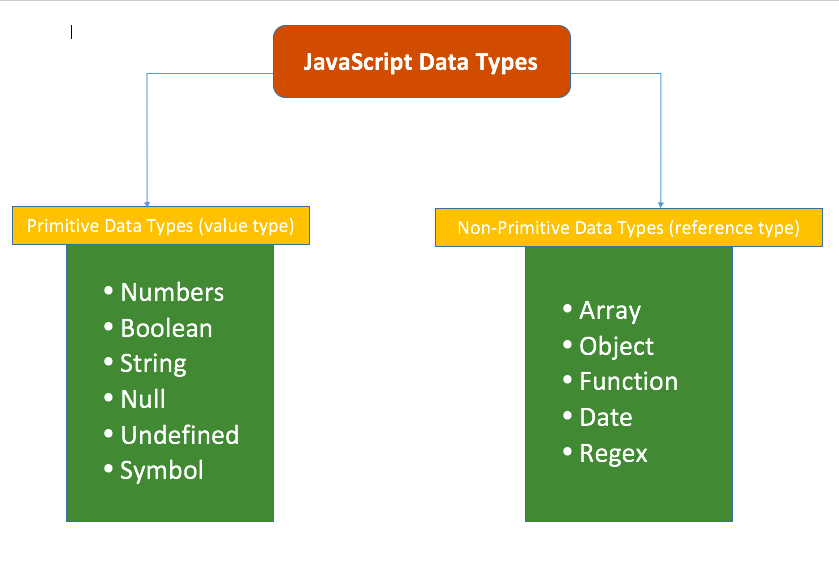
Primitive data types are defined in JavaScript, including the Number, String, Boolean, Undefined, Null, and Symbol types. Non-trivial data types do not have a member, and it is this member that is specified.
Variables in JavaScript have data types that specify what kind of data they contain and what types of data they can store. Primitive and non-primitive data types are two types of data that are available in JavaScript. In the following example, we’ll look at a primitive data type. Non-primitive data types can be found in the following categories: Object properties and methods are the property and method classes of JavaScript. Arrays can store more than one element under a single name in JavaScript. A number must be initialized without a value, and the following output is produced when that value is not found.
Primitive Vs Non-primitive Data Types In Javascript
There are several differences between primitive and non-primitive data types when using JavaScript. Primitive data types are defined by the Java language, whereas non-primitive data types are created by the developer and do not require Java to define them. Primitive data types, on the other hand, are limited to numbers, strings, and arrays, whereas non-primitive data types can include any type of data. Finally, size of data structures can vary depending on their primitive and non-primitive data types, and vice versa.
What Is Primitive And Reference In Javascript?
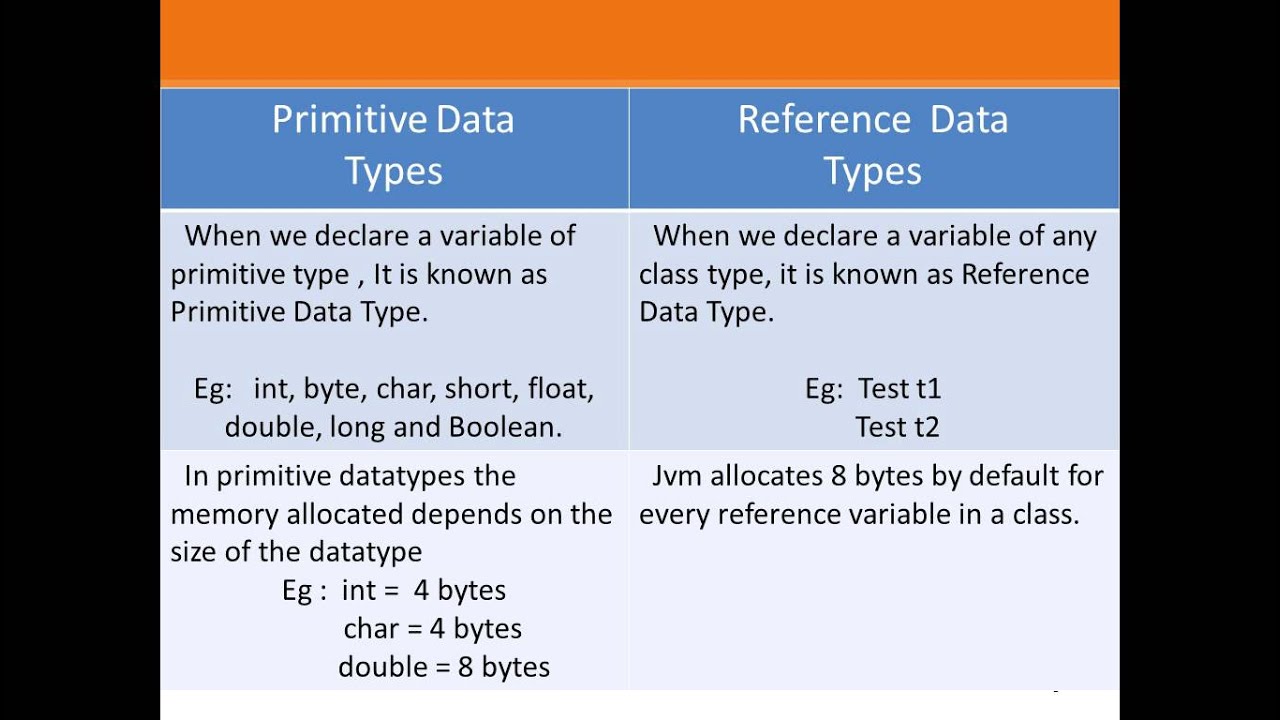
In Javascript, primitive values are values that are not objects, and they have no methods. They are: strings, numbers, booleans, and null. Reference values are values that are objects, and they have methods. They are: arrays, functions, and objects.
Variables in JavaScript can contain either primitive values or reference values. Primitive values and reference values appear to be the same on the surface, but they differ significantly under the hood. They are similar in the way they store their value, but they differ in how they can be retrieved. The location of the leo object in memory is referred to by using a variable called leo and assigning it to whatever the in-memory value is of leo. When we modify snoop.name, we’re referencing the same memory location as snoop and leo, so we’re also referencing the same memory location as leo.name. Because both values are equal, the two values must be compared to determine their true nature. When comparing leo and leito, we get the false impression that leo and leito are identical. Reference values are compared to or their memory or reference are used to determine their reference value. Primitive values remain always immutable because they can only be replaced and never changed, as far as I am aware.
Copying Primitives And References In Javascript
Arrays of primitive data types are used to represent simple values like integers and strings in Javascript. A reference is a pointer to a different object. In contrast to primitive values, a reference value can be changed, updated, or deleted with the help of the reference value. When a primitive value is copied from one variable to another, a separate value copy is created.
Primitives and references are useful because they aid in the creation of objects. When referring to another object, reference points to that object, whereas primitive points to simple values. Because no multiple copies of the same value are needed to work with objects, you can use this method more efficiently.
What Is Primitive String In Javascript?
A primitive string is a data type that represents textual data in computer programming. A primitive string is a string of characters that is not an object and has no methods.
Primitive strings are sequences of characters that do not belong to any other property. Each byte in a bytes array is one or more bytes long, and it is only possible to access it through the bytes array. Using the String class, you can work with primitive strings in a variety of ways. Primitive strings can be converted into objects in the most significant way. The toString() method can also be used to convert an object to a primitive string. You can return a string containing the name and all of the fields associated with the object if you use this method. Primitive strings can be useful when you need to create a sequence of characters that can’t be represented by an object. Primitive strings are also useful when you are working with bytes that are not represented by objects in a program. Primitive strings have a lower power than object-based strings. You cannot use the length() method if you want to find out the length of a primitive string. The length method can be used to find the length of an object-based string, but it must be set using the length method. Primitive strings are not as flexible as object-based strings. If you use the String class, you cannot create an empty string. The String class, on the other hand, can be used to create an empty string based on objects. Primitive strings can be useful in situations where you need to sequence bytes or characters that an object cannot represent, or where you need to sequence characters that are not represented by an object.
Primitive Types In Javascript
Primitive types, in general, do not contain any methods or properties. Strings, numbers, Booleans, nulls, undefineds, and symbols are just a few of the primitive types in JavaScript.
Strings are data types that don’t have any methods or properties, which is why they are referred to as primitives. The literal is a string that has only one or two quotes. Primitive strings are those that are returned from a String call when the non-constructor context is not present.
What Is Primitive And Non-primitive Value?
In general, the distinction between primitives and non-primitives is that primitives are unmovable and non-primitives are mutable. The most basic definition of muted values is that they can be changed after they have been created. Mutant values are those that cannot be modified after they have been created.
Data structures are described as the processes by which the memory organizes data. The data can be organized in either linear or non-linear fashion. Primitive data structures are important types of data structures because they store only one type of data. A primitive data structure can be seen in the image above, while a non-primitive data structure can be seen elsewhere. A primitive data structure is essentially a data structure that can hold only a single value in a specific location. Primitive data structures include float, character, integer, and pointer. Non-primitive data structures, such as those, can be found in a variety of locations and have multiple values. The types of data structures are further classified into two categories: linear and non-linear.
Reference types are not objects because they are not. It is not possible to create a reference type with a constructor. The new keyword is used to create a new instance of the reference type. Reference types are also known as simple types because they cannot be created using variables.
They are also referred to as primitive types because they are not objects.
Primitive types are those that are not objects.
Are Is Primitive Or Non Primitive?
In Java, primitive types are distinguished from non-primitive types by the following: Primitive types are pre-defined. Non-primitive types are not defined by Java and are created by programmers. In contrast to primitive types, non-preferential types can call methods to perform specific operations.
What Is Primitive And Non Primitive Data Type In Javascript?
js contains two types of data: data types and types. The fundamental distinction between primitive and non-primitive values is that primitive values are immutable, whereas non-primitive values are mutable, Primitives are stored by value, and Non-primitive (object) are stored by reference.
Non-primitive Values In Javascript
Primitive values in JavaScript include numbers, strings, Booleans, nulls, and undefined. A non-primitive value is an object, such as a function or an array. A primitive is a model of a universal state, whereas a non-primitive is a model of a mutable state.
The JavaScript language has two types of data: primitive and non-primitive. Primitive values do not contain properties, but they do contain some basic information. Non-primitive values (aka Complex/Special Values) are more complex data types. This is an alternative way to refer to values that do not have primitive properties. A JavaScript array, despite being a type of object, can do things differently than a regular object. The typeof operator can be used to prove the presence of arrays as objects in the examples above. Functions are unique in that they have properties, but they are not the same as objects.
Aside from the prototype, you have access to the material. Functions, for example, are represented by the Object. Every value type that isn’t a primitive is considered an object in JavaScript, including functions. You can use the do Something() syntax to call a specific type of object. We call objects and functions complex because of the wide range of options they have, as opposed to primitive types like numbers and strings.
Why Non-primitive Data Structures Are More Efficient
Primitive data structures are inefficient in memory because they can store multiple types of data. Non-primitive data structures are more efficient. Primitive data structures have only one type of data to store.